What a Real Research Gap Looks Like: Rebuilding My Thesis Proposal From the Ground Up
What a Real Research Gap Looks Like: Rebuilding My Thesis Proposal From the Ground Up
This blog post is about the rebuilding of a master’s thesis proposal after the original version was judged too broad, underdeveloped, and not rigorous enough for proper research. It explains how the revision process went beyond simply changing the topic or rewriting sections. The post focuses on the deeper learning that came from reworking the project: learning how to read literature critically instead of just collecting references, how to define a real research gap with precision, how to narrow an overloaded scope, and how to turn a vague proposal into a defensible study design.
This blog post is about the rebuilding of a master’s thesis proposal after the original version was judged too broad, underdeveloped, and not rigorous enough for proper research. It explains how the revision process went beyond simply changing the topic or rewriting sections. The post focuses on the deeper learning that came from reworking the project: learning how to read literature critically instead of just collecting references, how to define a real research gap with precision, how to narrow an overloaded scope, and how to turn a vague proposal into a defensible study design.
The previous post ended with a diagnosis: the original proposal had been approved but could not be executed at the level of rigor the research required.
The gap was asserted, the study design was incomplete, the scope was overloaded, and the literature section was a list of references rather than a critical argument.
This post is about what rebuilding that actually required. Not just what changed, but what the process of changing it involved, because I think that process is where the most transferable learning lives.
The difference between reading for coverage and reading critically
When I put together the original proposal, I read papers to establish that the field existed and that my topic was within it. That produces a reference list. It does not produce a literature review, and it does not produce a defensible gap claim.
Rebuilding the gap required a different kind of reading. For each paper, the question was not “does this relate to my topic” but “does this answer my specific research question, and if not, precisely where does it stop?” That sounds like a small shift. It is not. It changes what you look for in a paper entirely. You stop reading for subject matter and start reading for the boundary of evidence.
Working through the literature with that question, I found three bodies of work that each approach what this thesis asks without closing it.
The three streams and where they stop
The first is AR in retail. There is substantial work here, but almost all of it evaluates smartphone or tablet AR rather than head-worn displays. The one large-scale study that does use AR smart glasses in a retail context, Pfeifer et al. (2023, n=308), measures perceptual and attitudinal outcomes: immersion, purchase-decision quality, brand perception. It does not measure whether shoppers find products faster, make fewer navigation errors, or experience lower cognitive workload. It answers whether shoppers feel better. It does not answer whether they perform better or at what cognitive cost.
The second stream is AR wayfinding. Qiu, Mostafavi and Kalantari published a systematic review of 88 AR wayfinding studies in 2025. Zero of those 88 studies were situated in a retail or grocery environment. The closest in method is NavMarkAR, a controlled evaluation of landmark-based AR wayfinding on HoloLens 2 with 32 participants in a university building. NavMarkAR is methodologically similar to what this thesis proposes. But it evaluates pure navigation. Grocery shopping is navigation interleaved with product search, product inspection, comparison decisions, and purchasing judgements. That compound task structure, where the shopper must simultaneously navigate, find, evaluate, and decide, does not appear anywhere in the building navigation literature. The cognitive demands are different in kind, not just degree.
The third stream is warehouse order picking. Multiple studies have used AR glasses for pick-by-vision tasks and measured outcomes with NASA-TLX and task completion metrics. These are the closest methodological precedents this thesis has. But they involve professional users performing repetitive retrieval tasks on familiar, memorised routes in a controlled industrial environment. The cognitive profile of consumer grocery shopping is fundamentally different: unfamiliar layouts, real purchasing decisions, social context, non-expert users encountering the device for the first time, and a richer, noisier information environment.
Three streams. Each approaches the question. None of them answers: does a head-worn AR system that integrates navigation, contextual product information, and quick comparison improve task performance, usability, and perceived cognitive workload in a grocery shopping context, measured by HCI instruments, against an unassisted baseline?
That is the gap. Not “nobody has studied AR in retail.” That statement is false. The gap is at a specific intersection of task structure, device type, and evaluation method that the existing literature has not reached.
When you can state it that precisely, and support each word with evidence from specific papers, you have a gap claim. Before that, you have an assertion.
What the requirements survey found
Before finalising the prototype scope, a requirements survey was conducted in March 2026 with twenty regular grocery shoppers. The findings established something important: real user need and real user hesitation coexist.
On the need side: 12 of 20 respondents identified difficulty finding a specific product as a primary pain point. 9 of 20 selected finding products quickly as the single most valuable feature AR could provide. 17 of 20 named price information and 14 of 20 named product details as the most useful data to have surfaced in-store.
On the hesitation side: only 4 of 20 reported they would feel comfortable wearing AR glasses in a grocery store. 12 of 20 rated the ability to control and turn off displayed information as very important. Privacy concerns, a feeling of being monitored, and worry about visual clutter were the top stated reservations.
That tension is exactly what makes the empirical study necessary. If users universally wanted AR glasses in stores, a prototype demonstration would be enough. If users universally rejected the idea, there would be nothing to evaluate. The interesting case is where user need and user hesitation point in opposite directions, because then the data from the study has to do real work in explaining what actually happens when people use the system.
The theoretical architecture
One of the things that changed most between the original and revised proposal is the theoretical grounding. The original mentioned the Technology Acceptance Model as a concept. The revision builds a three-way theoretical tension that predicts competing outcomes and uses NASA-TLX subscale analysis to disentangle them.
Situated Cognition (Suchman, Lave) predicts that spatially anchored AR overlays will reduce cognitive demand by offloading spatial memory and information retrieval to the environment. Instead of remembering which aisle has pasta, the system shows the way. Instead of reading fine print on packaging, key data appears in the visual field. This predicts improved task performance and reduced Mental Demand on NASA-TLX.
The Technology Acceptance Model predicts that even if AR improves objective performance, acceptance depends on perceived ease of use and perceived usefulness. The survey data, only 4 in 20 comfortable with AR glasses in stores, suggests that social discomfort and device unfamiliarity may elevate Frustration and Effort subscale scores even if Mental Demand decreases. Performance and acceptance can diverge.
Cognitive Load Theory predicts that AR can simultaneously reduce extraneous load, eliminating aimless searching, and introduce new extraneous load: visual clutter, split attention between real products and virtual overlays, and the cognitive overhead of managing an unfamiliar device. The net effect depends entirely on specific design decisions, which is precisely what the study evaluates.
These three frameworks do not agree. That disagreement is what makes the study interesting beyond a binary “does it work” question. The subscale structure of NASA-TLX, separating Mental Demand, Frustration, Physical Demand, Effort, Temporal Demand, and Performance, is what allows the study to see which theoretical prediction held and where.
What the study design looks like now
The study is a within-subjects controlled comparison: every participant experiences both conditions, counterbalanced for order. Sixteen to twenty participants, sufficient to detect medium to large effects, the appropriate target for a prototype comparison where meaningful UX differences are expected. Each participant completes a shopping task of six items, two of which require choosing between alternatives based on a stated criterion.
The AR condition runs on Meta Quest 3 in video pass-through mode. The baseline is unassisted shopping with natural phone use: a paper list and free access to their personal smartphone, representing how people actually shop today. This baseline choice was deliberate. The original proposal described the baseline variously as a smartphone list, a 2D map, or manual search. Those are three different conditions with different cognitive profiles. The revision commits to one.
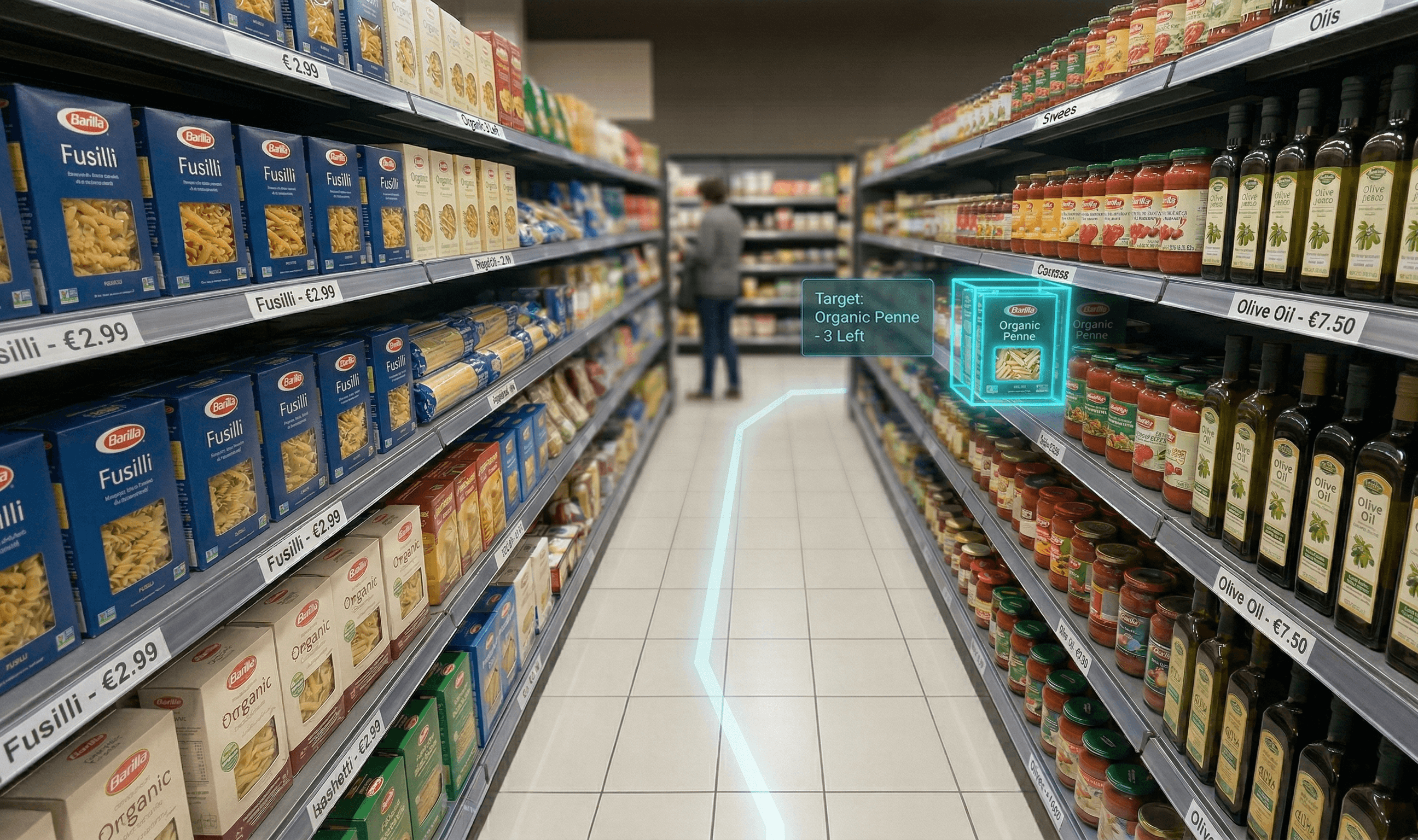
The prototype scope is honest about what it contains and does not claim. Three features: floor path navigation to each item, proximity-triggered product information overlays, and a quick-comparison display for the two items requiring a choice. No live IoT backend. No recommendation engine. No voice interaction. Contextual data is pre-loaded as local JSON. The proposal says this directly rather than framing it as “IoT-like signals.” What is being evaluated is a specific AR overlay interface for a specific task set in a specific context.
What the contribution is, honestly stated
This thesis does not claim to produce a generalizable framework, a novel interaction technique, or a theoretical contribution to HCI. Its contribution is empirical and situated: the first controlled HCI evaluation of a head-worn AR grocery shopping assistant that combines navigation, product information display, and comparison overlays, measured against an unassisted baseline, using task performance metrics, SUS, and NASA-TLX.
Qiu et al.’s 2025 systematic review found zero retail-situated AR wayfinding studies across 88 papers. Wolniak et al.’s 2024 review of digital grocery transformation states explicitly that AR in grocery “has not been studied in the academic field yet.” Even if the hypotheses are not confirmed, even if the AR system is slower or produces higher workload than unassisted shopping, that finding is valuable. It is the first HCI-level benchmark for this application context. Null results in a previously unevaluated space are not failures. They are data points the field did not have before.
A contribution does not have to be large to be genuine. It has to be specific, verifiable, and situated within evidence that shows what question it is actually answering.
That is what the rebuilt proposal is. A specific question, a demonstrated gap, a study designed to answer it
You can have the review of the Proposal here https://mseymur.framer.website/masters-proposal
The previous post ended with a diagnosis: the original proposal had been approved but could not be executed at the level of rigor the research required.
The gap was asserted, the study design was incomplete, the scope was overloaded, and the literature section was a list of references rather than a critical argument.
This post is about what rebuilding that actually required. Not just what changed, but what the process of changing it involved, because I think that process is where the most transferable learning lives.
The difference between reading for coverage and reading critically
When I put together the original proposal, I read papers to establish that the field existed and that my topic was within it. That produces a reference list. It does not produce a literature review, and it does not produce a defensible gap claim.
Rebuilding the gap required a different kind of reading. For each paper, the question was not “does this relate to my topic” but “does this answer my specific research question, and if not, precisely where does it stop?” That sounds like a small shift. It is not. It changes what you look for in a paper entirely. You stop reading for subject matter and start reading for the boundary of evidence.
Working through the literature with that question, I found three bodies of work that each approach what this thesis asks without closing it.
The three streams and where they stop
The first is AR in retail. There is substantial work here, but almost all of it evaluates smartphone or tablet AR rather than head-worn displays. The one large-scale study that does use AR smart glasses in a retail context, Pfeifer et al. (2023, n=308), measures perceptual and attitudinal outcomes: immersion, purchase-decision quality, brand perception. It does not measure whether shoppers find products faster, make fewer navigation errors, or experience lower cognitive workload. It answers whether shoppers feel better. It does not answer whether they perform better or at what cognitive cost.
The second stream is AR wayfinding. Qiu, Mostafavi and Kalantari published a systematic review of 88 AR wayfinding studies in 2025. Zero of those 88 studies were situated in a retail or grocery environment. The closest in method is NavMarkAR, a controlled evaluation of landmark-based AR wayfinding on HoloLens 2 with 32 participants in a university building. NavMarkAR is methodologically similar to what this thesis proposes. But it evaluates pure navigation. Grocery shopping is navigation interleaved with product search, product inspection, comparison decisions, and purchasing judgements. That compound task structure, where the shopper must simultaneously navigate, find, evaluate, and decide, does not appear anywhere in the building navigation literature. The cognitive demands are different in kind, not just degree.
The third stream is warehouse order picking. Multiple studies have used AR glasses for pick-by-vision tasks and measured outcomes with NASA-TLX and task completion metrics. These are the closest methodological precedents this thesis has. But they involve professional users performing repetitive retrieval tasks on familiar, memorised routes in a controlled industrial environment. The cognitive profile of consumer grocery shopping is fundamentally different: unfamiliar layouts, real purchasing decisions, social context, non-expert users encountering the device for the first time, and a richer, noisier information environment.
Three streams. Each approaches the question. None of them answers: does a head-worn AR system that integrates navigation, contextual product information, and quick comparison improve task performance, usability, and perceived cognitive workload in a grocery shopping context, measured by HCI instruments, against an unassisted baseline?
That is the gap. Not “nobody has studied AR in retail.” That statement is false. The gap is at a specific intersection of task structure, device type, and evaluation method that the existing literature has not reached.
When you can state it that precisely, and support each word with evidence from specific papers, you have a gap claim. Before that, you have an assertion.
What the requirements survey found
Before finalising the prototype scope, a requirements survey was conducted in March 2026 with twenty regular grocery shoppers. The findings established something important: real user need and real user hesitation coexist.
On the need side: 12 of 20 respondents identified difficulty finding a specific product as a primary pain point. 9 of 20 selected finding products quickly as the single most valuable feature AR could provide. 17 of 20 named price information and 14 of 20 named product details as the most useful data to have surfaced in-store.
On the hesitation side: only 4 of 20 reported they would feel comfortable wearing AR glasses in a grocery store. 12 of 20 rated the ability to control and turn off displayed information as very important. Privacy concerns, a feeling of being monitored, and worry about visual clutter were the top stated reservations.
That tension is exactly what makes the empirical study necessary. If users universally wanted AR glasses in stores, a prototype demonstration would be enough. If users universally rejected the idea, there would be nothing to evaluate. The interesting case is where user need and user hesitation point in opposite directions, because then the data from the study has to do real work in explaining what actually happens when people use the system.
The theoretical architecture
One of the things that changed most between the original and revised proposal is the theoretical grounding. The original mentioned the Technology Acceptance Model as a concept. The revision builds a three-way theoretical tension that predicts competing outcomes and uses NASA-TLX subscale analysis to disentangle them.
Situated Cognition (Suchman, Lave) predicts that spatially anchored AR overlays will reduce cognitive demand by offloading spatial memory and information retrieval to the environment. Instead of remembering which aisle has pasta, the system shows the way. Instead of reading fine print on packaging, key data appears in the visual field. This predicts improved task performance and reduced Mental Demand on NASA-TLX.
The Technology Acceptance Model predicts that even if AR improves objective performance, acceptance depends on perceived ease of use and perceived usefulness. The survey data, only 4 in 20 comfortable with AR glasses in stores, suggests that social discomfort and device unfamiliarity may elevate Frustration and Effort subscale scores even if Mental Demand decreases. Performance and acceptance can diverge.
Cognitive Load Theory predicts that AR can simultaneously reduce extraneous load, eliminating aimless searching, and introduce new extraneous load: visual clutter, split attention between real products and virtual overlays, and the cognitive overhead of managing an unfamiliar device. The net effect depends entirely on specific design decisions, which is precisely what the study evaluates.
These three frameworks do not agree. That disagreement is what makes the study interesting beyond a binary “does it work” question. The subscale structure of NASA-TLX, separating Mental Demand, Frustration, Physical Demand, Effort, Temporal Demand, and Performance, is what allows the study to see which theoretical prediction held and where.
What the study design looks like now
The study is a within-subjects controlled comparison: every participant experiences both conditions, counterbalanced for order. Sixteen to twenty participants, sufficient to detect medium to large effects, the appropriate target for a prototype comparison where meaningful UX differences are expected. Each participant completes a shopping task of six items, two of which require choosing between alternatives based on a stated criterion.
The AR condition runs on Meta Quest 3 in video pass-through mode. The baseline is unassisted shopping with natural phone use: a paper list and free access to their personal smartphone, representing how people actually shop today. This baseline choice was deliberate. The original proposal described the baseline variously as a smartphone list, a 2D map, or manual search. Those are three different conditions with different cognitive profiles. The revision commits to one.
The prototype scope is honest about what it contains and does not claim. Three features: floor path navigation to each item, proximity-triggered product information overlays, and a quick-comparison display for the two items requiring a choice. No live IoT backend. No recommendation engine. No voice interaction. Contextual data is pre-loaded as local JSON. The proposal says this directly rather than framing it as “IoT-like signals.” What is being evaluated is a specific AR overlay interface for a specific task set in a specific context.
What the contribution is, honestly stated
This thesis does not claim to produce a generalizable framework, a novel interaction technique, or a theoretical contribution to HCI. Its contribution is empirical and situated: the first controlled HCI evaluation of a head-worn AR grocery shopping assistant that combines navigation, product information display, and comparison overlays, measured against an unassisted baseline, using task performance metrics, SUS, and NASA-TLX.
Qiu et al.’s 2025 systematic review found zero retail-situated AR wayfinding studies across 88 papers. Wolniak et al.’s 2024 review of digital grocery transformation states explicitly that AR in grocery “has not been studied in the academic field yet.” Even if the hypotheses are not confirmed, even if the AR system is slower or produces higher workload than unassisted shopping, that finding is valuable. It is the first HCI-level benchmark for this application context. Null results in a previously unevaluated space are not failures. They are data points the field did not have before.
A contribution does not have to be large to be genuine. It has to be specific, verifiable, and situated within evidence that shows what question it is actually answering.
That is what the rebuilt proposal is. A specific question, a demonstrated gap, a study designed to answer it
You can have the review of the Proposal here https://mseymur.framer.website/masters-proposal